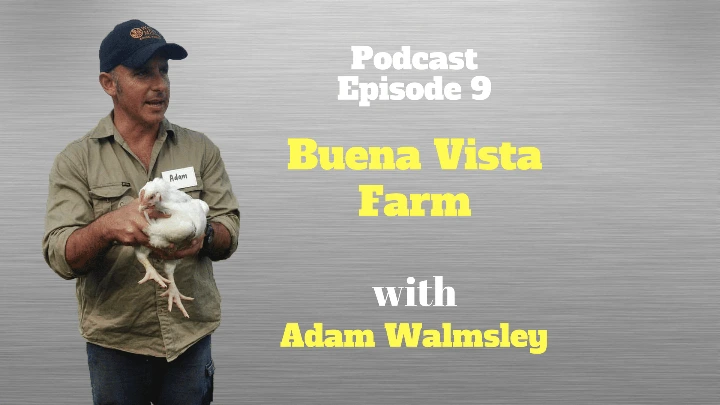
In this podcast, Adam and I discussed his farm and how he developed it. He shared his farm’s past and how he developed it up to this point.
Transcription:
Daniel: Daniel OBrien here, welcome back to Greengrasseggfarming.com, I have another very special guest today, Adam Walmsley from Buena Vista Farm, welcome!
Adam: G’day Daniel, thanks for having me.
Daniel: You’re very welcome, I’m very much looking forward to today’s podcast because we’ve known each other for a few years now and I love going to your farm – it’s just a brilliant farm and it’s not on the ocean, but it’s pretty close to the ocean. Tell people about your farm, you could hit a golf ball into the water, would that be about right?
Adam: Yeah pretty close, if you were Tiger Woods, you’d manage it! We’re very fortunate, it’s a nice location, it has a few distractions.
Daniel: Tell me a bit about your farm and your location so for people that have never been to your website or Facebook page, just describe your farm and what it looks like and where it is.
Adam: Sure, so we are located at Gerringong which is on the south coast of New South Wales, about two hours south of Sydney. We’re right on the coast and we got the escarpment behind us. It’s my wife Fi’s family farm, so the Weirs have been farming here since the 1850’s and up until recent it was very much dairy country so this farm it’s always been running as a dairy. Until that, I think it was year 2000, Fi’s dad sold the herd just before the regulation came in and he was sort of in semi retirement.
We were still living in Sydney and then we came down and thought “Well we got this farm here, we might as well have a crack at doing something with it”. It’s lovely open pasture, quite rich volcanic basalt soils. About 1.4 or 1.5 meters of rain a year on a dry year, so we’re very fortunate there, we got pretty good fertility, not many trees, it’s pretty open because it’s been cleared by the cedar cutters originally and so we working on a lot of tree planting.
It’s a good place to start, the size it used to be that we farm 18 acres which is a tiny little farm, the original farm is to be much bigger about 200 acres nobody used, chunks been sold off too due to family successions and things but we feel fortunate to have access to that 18 acres and it’s actually it’s more than enough for us, we laugh at how busy we are just with that land size and I don’t think we’re in any hurry to get anymore, we make the most of it.
Daniel: That’s interesting with small farms, I’ve heard stories new people said about west like new south wales and it come of like 5000 acres like huge farm and they move to the coast somewhere to semi-retire and they buy like a hundred acres and think “This will be a breeze, I had 5000 acres”. What they sort of forget, they learn pretty quick, if you want to earn the same money from a hundred acres and you did 5000, you’ve got to farm a little bit more intensively. Now that compounds for you, you got 18 acres and we’ll talk about soon all the things you do on that farm. But first, before you said in the year 2000 your father-in-law got rid of the herds so you were ready to move down to the farm. Tell me a little bit of your background, what were you doing before you’re a farmer?
Adam: Yes, I didn’t have a background in farming, I grew up in Armidale in New South Wales so I grew up in a country but not on the land. So I was a retailer, pretty much my whole professional working life, I work for IKEA for many years, the big Swedish furniture retailer so I’m very good on Allen keys and you know instructions and getting lost in mazes of buildings. Not so relevant on practical hands on farming so to speak, in Fi she’s got very diverse background, she’s a medieval historian by academic training but then a financial services marketing person by professional means. That took us all around different parts of Australia, we work on overseas for a while but exactly not directly relevant to day to day farming.
Daniel: Yeah, so you’ve both come from corporate backgrounds?
Adam: Oh yeah.
Daniel: You made the journey unto the 18 acres, tell me about the first two or three years when you like “Yeah, we gonna be farmers” what was that like? What was the good, bad and crazy things you did when you first started getting your hands dirty?

Adam: Yeah, look it was an amazing journey, there were incredible heights and quite severe lows as I think you’d expect when you try something completely new. Fi’s one of four kids and for years they’ve been trying to work out their family’s succession and, ‘Did anyone wanna move to the farm?’ – none of her brother’s and sister’s really felt very passionate about moving back to Gerringong but Fi always did and so in the back of our mind for years we have sort of “Oh we’ll go to the farm 1 day” but it was always that 1 day and I think finally, I don’t know I just got sick on driving on permanent road and the rat race, it wasn’t that I didn’t like my job but it just, I thought there has to be more to life.
And so I quit my work quite quickly and we moved out, we had absolutely no idea really what we wanted to do, apart from the fact that we wanted to make a living on a farm, so we didn’t want a hobby farm so we speak, we wanted to actually live and work and work together on a business that related to the location that we had.
So we moved out and we rented a house out of town for the first year. We weren’t actually living on the farm and that’s why we had a chance to explore certain things, so we started with a couple of backyard chooks and we bought two little pigs and did a lot of baking and bits and pieces. When you challenge yourself like that we find it quite invigorating because you had to work out a way to make money. We chose not to gone you know to get office jobs or anything, we thought ‘We’ve got to make the most of this’.
I think that first exploratory year, we ruled out some things that just didn’t resonate with us and then we found that ok “You know what, chickens are a winner – they give you an income everyday with their eggs”. Pigs – they’re pretty entertaining, they’re a nightmare to handle sometimes, but they keep you in dinner party stories, you know that’s if we could ever afford to have a dinner party.
There were lots of bits and pieces then we finally moved on to the farm and that was really the catalyst, this is only 4 years ago. And that’s where we sort of got cracking, we sat down and thought about our opportunities, and one is the view – it is a pretty special location in terms of our lookout, we look at ocean, we’ve got a mountain behind us. There’s not many farms where you got rolling green hills to the actual surf line.
We thought ‘Right, we have to farm the view, that’s one job and then what else can we do on the space of this sort of land size. Somebody gave me a book of Joel Salatin, the US farmer. I think the book was called “Yes you can farm or so you can farm”.
I was like “Yeah! I can do that, I can get a crack on it” because his philosophy is all about small sort of scale family farms, rotation, like no fixed infrastructure, rotating everything, stacking, so not just having one form of livestock for instance and selling direct and all of those things. Yes yes I can do that, I’ll give it a shot anyway you know, nothing like blind ignorance.
My father-in-law he calls me the ‘Google farmer’ when things are going well because I don’t pretend to know much or didn’t when I first started, because I just read voraciously, I Googled everything, I watched YouTube, I talk anyone that had experience with things.
And then he call’s me to ‘Fiasco Farmer’ when things don’t quite go to plan because I have to go up and ask him how he would do it you know, proper old school farming and we fix it so we can get on with things again.
We bring quite diverse skillsets so my background was retailing, Fi’s apart from medieval history and marketing, she’s a super passionate cook and really quite passionate about ‘from scratch cooking’ an old school making things, you know the simple lost arts. And so we decided that actually a food business would also compliment what we were doing on the farm, so one of the first things we did was actually convert part of the old dairy that was no longer use into commercial kitchen and that’s where we started to produce food for markets, local markets.
We had a lot of request, people want to learn these things so we thought “Ok, let’s do something about that” so we started to run an on-farm cooking school and today that’s a big part of our overall business. So we run workshops most weekends on the lost traditional arts of how to make butter and how to make ferments and breadmaking and simple home dairy stuff. That’s terrific and it compliments the agricultural side of things like the egg business and the meat bird business and the beef and the pigs work really well. I like it because it’s you know, an average week you’re doing a bit of everything you’re not just specializing in one particular thing.
Daniel: Yeah and I think what people were saying before was, with 18 acres you need to lay that farm, you can’t just go “Ok, how many cattle am I holding” because that’s not gonna give you much income so I love what you have done in such a small parcel of land and I think it gives a lot of people hope, like whatever you’ve got, you always think the grass is greener on the other side of that, if you have 5 acres you’ll think “Oh if only I had 18”, if you have rainfall you'd think “Oh I wish it wasn’t this muddy”. Whatever it is you’ll wish it is different.
To see what you’ve done like on 18 acres there, you’ve got almost like a tourism arm of teaching things and that’s something I wanna talk to Fiona about on the up and coming podcast – ‘How does farm tourism work?’ because that effectively what you’ve into, you’re bringing people to the farm, teach them some stuff and they get to experience your lifestyle and learn things that you are doing on the farm.
Adam: Yeah, it’s a really interesting sort of thing and you’ve got to be pragmatic because we had that life goal of working and earning our living from the farm. Not wanting to have an off-farm income or somebody working on a farm and that’s where you’ve really gonna think “Ok if I’ll run 150 chickens, that’s not really gonna pay the bills. Ok, how can I integrate beef production in that and then a market garden” and then the other tangent of “How can we build our brand outside the farm?” and that’s food production and markets and workshops and things.
It’s an evolving process so it’s certainly, it’s shaped over the last couple of years and we’re getting better at refining what is relevant and what works for us, what we can enjoy and also what’s financially viable.
Daniel: So tell me what are the things you are doing on your farm? I know you’ve got chickens, do you still have bees? How was the bees going?
Adam: Bees are tops, I love bees, they just the most fascinating creatures in what they are able to produce and you watch them communicating, like you open their hive in the middle of summer and you’re watching them coming and do their little bum wiggle dance and they’re figure of eights and they’re communicating where the pollen or nectar is for other bees to go and check it. They’re phenomenal and raw honey, just straight up from the hive it’s pretty amazing stuff, we’ve got eight beehives and four of those are Warre hives and then four are Langstroff that’s sort of more standard, they produce more honey but it’s a different way of raising the bees.
We got them actually for pollination and for farm fertility and the honey is sort of a by product that we’re still pretty happy with, but we still don’t work them super hard and it’s not about maximizing the absolute honey flow, because we want a good environment for everything else on the farm.
Daniel: So that’s the pollination for the market garden?
Adam: Yes! Market garden and then growing the food forest and things as we planning more and more things around the farm. We started with chickens that was way back when, we actually started with a little fixed yard and 50 chickens, that grew until we got one of your caravans, the 130 and then we got the second caravan. We’re running layers and then we also got into meat birds, that’s probably the biggest component of our agriculture output at the moment is pasture raised meat birds.

We followed the Joel Salatin sort of pens for a little while but they didn’t really work for us on our terrain and also with our winds and the temperature in summer so we’ve changed the shelter a bit, we do day ranging – basically we’re using electrified poultry nets, the same one’s that we used on their layers and that’s really good and we’re very proud of the product there, ironically now we actually stopped selling eggs because all the eggs go into our custard production. Custard is one thing that we sell through the farmers market, so using a local milk from a local area, and that’s a bit of a ‘cult product’ now.
In addition to that we’ve got some pigs only we got two breeding sows at anyone time and we borrow a boar regularly and that equates to two litters a year per pig, and we sell that direct off the farm once it’s been butchered and then we’ve got seven head of beef so ‘massive herd!’, they’re our lawn mowers so they can see working on using the grass and getting the grass down to the right length for the chickens, and we process a couple of them a year.
Then we got a market garden, that almost broke me, well it did break me a couple of times trying to do it because it’s about 900 square meters of beds and it was just too much on top of, when you talk about refining your business model, and that was just fully labour intensive. It was just a trial and I couldn’t get on the top of the weeds, so we just grow little things.
Fortunately we found a woman called Linda who came out from another farm and she approached us and say “Hey look, I think you need me” and so we share farm now. Linda runs the market garden, it’s her business, we harvest from it as we need for our business needs and she sells the produce and she also works on the farm, helping as well. I’m really pleased with that because it’s a lovely partnership and it fits in, there’s a synergy – we like having a market garden on the farm, it’s great for our cooking workshop, some things like that.
We’re also using fertile productive land, Linda’s creating a living out of it and also getting the benefit of living on a farm as well. That’s pretty good and then we’ve got the bees and we also got coffee, we got a hundred coffee trees which isn’t really a commercial size crop but it does sell, we produce about 60 kilos of green bean coffee a year which is enough for us as a family to get through and then we run a few workshops and if you come and do a workshop on our farm you’ll always be drinking our coffee which is nice.
Daniel: Yeah, I remember when I was 1st at your farm and I’m not like, I drink coffee occasionally but I’m not like a coffee connoisseur that goes out for coffee every day, someone said ‘The coffee is grown on the farm’ and I was like ‘What?’ I thought coffee was mostly grown in countries, I know I grow a bit on Australia but I know where not generally a coffee growing country, and I thought ‘How does that work?’ I remember you showing me, you’ve got these coffee trees because you don’t get frost there, is that the reason they were planted back in the day?
Andrew: Yeah, it was Fi’s dad, when he retired from dairy because you know when you’re farming you can’t actually retire – you still got some ‘stuff’ to do. There was talk at the time of creating a south coast coffee growing cooperative and in the end it was only a few farmers that put in trees and this was a test crop that went in, on an old dairy lounging paddock so it’s incredibly fertile. It’s got a low microclimates created with a windbreaks around it, we’re so close on the coast that rarely get any frost. As you say it’s a tropical plant that grows at altitude so we grow it in a subtropical sea level and it thrives, it’s really good, it’s very resistant to pests and disease and I think the only thing about where we grow is a slightly lower caffeine content as a result of that latitude and also the altitude but it still taste nice.
It’s a bit of a pain in the bum at coffee at picking time because you know it’s hard work and you’re picking repeatedly over a two month period but you forget about that when you’re drinking your morning latte and you say “This is alright, this is zero food miles”. Ok I’ve done that. So yeah it’s just something different, it doesn’t take much time in the total picture of things.
Daniel: One thing I love is with the market garden you’ve got help, I think that’s important for some people rather than trying to do everything yourself, bring help in.
Andrew: Absolutely, with small scale farming you get to farm the temptation is to do more and more things and each time you doing that you’re fragmenting so in my corporate world, part of my job is to analyse businesses and make sure that you’re doing the right thing and you’re being efficient and your being ruthless, like if it’s not profitable or not contributing to a bigger goal then you scratch it. You change hats and you’re your own boss on a small farm and you just keep adding stuff like “Ohh, get two goats in, we’ll get that in and geese in, and ducks” and suddenly you realize that you got this menagerie of animals that will cost you a lot of money in feed and not delivering you anything to the bottom line, you’ve got to be pragmatic about and apart the learning is I think realizing when things aren’t working or whether they don’t give you joy or where it’s just not effective.
We had a choice to make the market garden bigger and buy lots of machinery for it so that we weren’t hand digging anything and that was essentially ploughs and bed forms and things like that but that’s a lot of money for still very little return from a veggie garden where is we wanted it just for the fresh produce and organically grown produce, that we could use and value add through the commercial kitchen to sell.
We don’t want to get too big, I get a lot of energy out of the share farming arrangement because I got a second set of brains on the farm, Linda’s really capable and she does a fantastic job at the market garden but it’s also nice having that extra support around the farm for when bigger jobs need doing and I can use her skill set and abilities helping me with my bits and pieces around the place. It’s a shared enterprise and we both gaining something out of it, it’s an extra living income.
Daniel: So tell me when you first started with the chickens, I know you have 50 chickens in a fixed coop and made a run at one side, did you go straight to 50 chickens when you moved back to the farm?
Andrew: I think we started with ten and then ten was really for us so in that first year that we moved down here, we were looking at just being self sufficient as much as possible for our family and then we realize that actually chickens is a bit of a winner, they’re entertaining, they give you that daily income.
There’s so much demand for fresh farm eggs even if this weren’t pastured eggs, these are fixed yard and they had green runs on things and they would let out during the day. I think we acquire a few stray chickens when we went to a chicken auction and then we bought a few so we’re about 50 but that was the limit of that fixed yard really because you know better than anyone there’s super destructive.
It became a management issue, we didn’t want to add anymore there but we wanted more eggs and I red Joel’s books about pastured eggs and I thought “Ok, I’m gonna get a mobile shelter”.
I thought “well I’m very good with Allen Keys”, but building stuff is not my strength and so I was looking at things, that’s where we came across your website.
At that time you are only doing the larger, the 450 caravans and we had a really long look at that, because I love the idea of what it represents in terms of an ability to manage a flock like that on our property where we could integrate it with all the other systems and actually enhance the fertility reform rather than destroy it and get eggs. Also importantly, it was clicking with me about managing your time and labour. You can’t treat your labor as farmer’s free and you’ve got to put a dollar value on it and so I was thinking “Ok, do the sums” and then looking your spreadsheets about the hours that you spent on collecting and washing eggs or grading them and packaging and it really made sense.
So that’s why we got talking and that stage we’re quite hilly and I was concern that the 450 was just too big a caravan to actually work on getting it levelled on some areas of our farm. So we packed it and I started looking at converting caravans of things and then it wasn’t long after you rang up and said “Hey, I got a prototype of this smaller one, do wanna give it a shot?” and we jumped to that chance and that’s the first of the 130’s.
Daniel: That was the very first one we produced, I think I must’ve had a conversation with your Fiona and I think you asked “Do you do a smaller one?” and that time I said “No, but we will one day” and obviously back then I wrote your name down I thought “Oh they’re after the smaller one” so when we came around to do it and I thought “Woah, I’ll give these guys a call” and I hadn’t met you or anything so it’s great that you were prototyping this brand new model on your beautiful farm – that’s good on both of us.
Adam: All was fantastic and when we got it was just such a relief to get the chickens out of that fixed yard and get them on the pasture all the time and we sort of lifting the rate of lay and also I think the quality of the eggs improved and I loved that because until that point we’ve been using fixed nesting boxes, filled with straw of wood shavings and our spending proportion is so much time on cleaning eggs or collecting them frequently to try and get them while their clean.
It was just so nice to look on the conveyor belt and wind them up and there’s your 99% of clean eggs, that system works really well. That was an integrated flock so we moved our house hens out, I think it was about half and half so I think we had 50 or 60 house hens and then we bought a new batch of hens to bring it up to the 130. That was terrific, that was probably 12 months later because we are selling every egg and the demand was huge so we bought a second 130 so we started to run two. Again, fabulous and it fit it in with our overall farm plan, the rotation seems to be fine that we just have two phases, working the cows first then the lays and then off to the meat birds after that. It’s a really good system and on that stage we we’re, that was about 300 hens on the farm laying and more and more of that production went in on our costed.
Daniel: Now you are in the point where you are not selling any eggs and you’re using them all for your farm so you’re value adding them on another layer.

Adam: For small farm like us, there’s not enough money on selling your agricultural output wholesale and even selling it direct, you’ve got to be smart about what you do. Even to this day we’re still getting heaps of requests for eggs but the reality is it’s worth a lot more to us in terms of income for us to value add those eggs that we have into our custard product which is fantastic in itself and it’s part of the ethos at least the component of it, is of the farm that we are selling. It works for us and it’s a great little system.
Daniel: So with the custard, is that something you sell direct from farm or the farmer markets? Where do you retail that?
Adam: When we first started the food business, we were selling of the farm and then after a couple of months we realize that it wasn’t particularly efficient way of doing it because every ten minutes you get a phone call from someone say “Oh, I’ll be there in 20 minutes” or “Can I just pick up a dozen eggs and some custard” and it was lovely having that face to face contact and selling to our community customers and chat with them but it also mean you never gonna get any work done, you’d be up the paddock and you have to come back and somebody is late and all for an eight dollar transaction.
Under our local council rules, if we wanted to have farm gate selling, we would have to make some significant changes to the farm in terms of dry way and turning line access which the investment in that kind of infrastructure wasn’t a big enough return on it through the farm gate sales, I mean this wasn’t nearly enough so then we make the decision that we would sell through a local co-op.
There’s a local food co-op that we support called Green Box which is fabulous and then there’s also some local markets and we started by doing weekend markets, but they weren’t great for us, I mean they kept us a supply and we earn our own money but they are very long day and weekend markets tend to be a lot of people just browsing or particularly in Gerringong people on holidays and having a look around and they’re not interested in buying fresh veggies and the sort of food staples that we sold.
Also all those weekly, all those markets were running monthly which means we have to go to a different one each weekend and at ate into our weekends. So then we transitioned from that to running workshops on weekends and Fi was part of a community that set up the kind of farmer’s market which was modled on a farmer’s market called Sage down at Maria, that’s an award winning one and it’s a weekday so Wednesday afternoon for three hours or three to six and it’s fabulous because it’s every week, it’s only short, because it’s in the afternoon.
You can actually a lot of your harvest or you prep the morning off so you get a super fresh produce. We found that it attracts an amazing number of locals that come into their weekly shopping with us now so we’re blown away about the support that we get in terms of people coming every week and buying whatever we’ve got as a part of their integrated weekly shop and it’s so much more efficient than a weekend market for us. Now that’s our main sales channel, so the farmers market and a little bit of the Green Box food corp and then we’ve just started selling a little bit through a couple of local cafe’s down in Berry. It’s something that’s potentially scalable for us in the future so the next step would be potentially hire a few extra people, there’s already one person that works part time in the kitchen with Fi and I think that’s an avenue that we’ll look in the year to come of seeing if we can boost the output of the food sales.
Daniel: Yeah fantastic, It’s just incredible with 18 acres and so many enterprises. It’s interesting to see your journey as you started with 50 hens you realize “Hey they gonna destroy this area of grass and turn in into a dirt patch” and right through to when you got the Chicken Caravan, you’re selling the eggs and then you’ve relooked at it and thought “We can actually make more money by value adding the eggs” and then also your retail channels, you saw the initial farmer’s market and then you’ve now moved to food corporations and a weekday, shorter farmer’s market which makes a lot of sense because I do know what you mean, I think farmer’s market are great for marketing, your right it is a long day, there is prep that goes into it.
I think where it can work if you’re doing massive volume if you’re turning up and you’re selling like a hundred or two hundred dozen, I think it’s worth-while but if you’re there and you’re only doing a transaction every 20 minutes, you could be doing something else on the farm that could probably make you a lot more money.
It’s interesting to see your journey and I think with anyone, you’ll see what works, what works for another farm, might not work for you like you are saying, those meat chicken cages you started of with something, it wasn’t working on your climate or your wind or whatever. I think it’s important for people to realize that, it’s easy enough for someone to listen to this podcast and go “I love to get 18 acres, I’ll do exactly that” – well, don’t put coffee in if you gonna get frost, you’ll gonna be a bit upset when it all dies.
It does take it a while of observation of “What’s gonna work for me?, how close am I to markets?, how big is my farm?, how many cattle and chickens can work together?”. Having that observation and giving yourself time and patience is important, otherwise you could be a frustrated farmer really quick.
Adam: I could agree more with you Daniel, I think the two skills that I’ve developed farming, one is the ability to fix things badly. But I fixed a lot of stuff right and you learn the art of “It doesn’t look pretty but you can keep patching something while you’re working on a better fix” you can repair it so that you still have water to your farm or on the electric fence in. And the other thing is observation, I think it’s rarely talked about, in a corporate world you got so much feedback in terms of keeping an eye on numbers and things but the joy of farming is out there when you start to appreciate the seasons and you’re looking at pasture growth and you’re looking at your chicken’s health and your observing them, stuff seems weird sometimes and if it is, it’s something doesn’t seem right, it probably isn’t and you need to dig into it but I love that it’s probably one of the most satisfying things.
I love that interaction and the observation, problem solving and working on things, you’ll never complete, you’ll never finished it, you’ve never mastered it. I think there’s so many points where you can start but you should carry on and find your own way that works for you, that the context is right for you and that it gives you energy and you enjoy doing what you do.
Daniel: Really look at the lifestyle you want to create. I remember in the early days when I still have the egg farm and I said “We can’t keep up with demand?” a lot of people would say that “Double your numbers or 10 times you numbers” and I think, I want a lifestyle, I still wanna have some time on the weekend to do kayaking or do something. You can do everything but what do you actually want to do and look at the lifestyle, especially if you’ve got a young family and we like “What fits in?” and I know a lot of people, they’ve got into chicken farming because their children are young and they want them to be involved in the farming industry.

With chickens that’s easy, if you run a beef stud, it’s a bit hard to draft cattle on the cattle yard with 600 kilo beef running through and there’s your three year old trying to help you. Look at what do you want and what’s gonna work for you because at the end of the day, this is your lifestyle because farming is a lifestyle. A lot of people could get to corporate and they might think it makes the dream come true and for some people it does but for others it’s like “Hang on, this is not what I’m after”. I think sometimes with that observation in farming, you can create something that’s good for you and i know some people, they love farmer’s markets and then every Saturday, they love selling your eggs and that’s them – it wasn’t me, I was happy to do it for a season but I thought “I can’t sustain this every Saturday” as you know, you need to get up early, preparing early, preparing to get into the market even if it’s raining and things. Workout what works for you so, I think observation and time, give it some time, you’ll find that.
Adam: You can’t rush farming because there are certain things that have to go on their own pace and you’ve got to fit them with that.
Daniel: I’ve seen many people like that “I’ve bought a farm” it’s almost like day one they’ll say “Oh, let’s do this, this, this and this”. They don’t even have the time to know where the wet spots are, so they could be putting the cattle yards in the swamp.
Adam: That farm is the feedback loop, you need to try things and see how the land or how the animals respond to that and work out. Is that what you want, is that the right outcome or have you over done it, is it under stock, all those things. It’s a fascinating process but it’s a change of mindset from a traditional job.
Daniel: Well, we’ve covered a lot today, we’ve covered egg lay chickens, market garden, bees meet chickens, pigs, beef, coffee.
Adam: Dairy goats Daniel.
Daniel: Dairy goats!
Adam: There’s only three and that’s really Fi’s folly, she wanted to make a goat’s cheese and that’s not commercial enterprise, that one’s just for her love of making cheese.
Daniel: And she’s making cheese now?
Adam: Not yet, they haven’t kidded so they’ll have their little kid soon and we’ll stop milking them. Needless to say, they’ve challenged my fencing techniques, a bit more work to be done there I think.
Daniel: I heard goats can be quite cunning.
Adam: Yeah, they are total escape artists but they’re pretty entertaining.
Daniel: For more information, people can go to buenavistafarm.com.au, is that correct?
Adam: Yes, we’ve got all the links and workshop information and farm informations on that website.
Daniel: Well thank so much for your time today, I’m sure we’ll talk soon and I’m sure I’ll catch up with Fi on the future episode and talk about Farm Tourism and how all that works and how you got into that as well, so thank you so much for your time today Adam.